
The delta that pays
Why a portable cognitive profile, strictly personal and authorized by its owner, doesn't sell "knowing more about you" but rather preventing your own tools — and the professionals you choose — from getting you wrong in operationally expensive ways
There's a conversation I've had too many times, and you probably have too, dear reader, in some variant. It happens over coffee, on a Zoom, in a meeting with a potential buyer. Someone mentions personality tests, and within half a second the killer line appears: "ChatGPT already does that for free, doesn't it?"
The line is interesting because it's almost right. Almost. And that "almost" is exactly, millimetrically, what justifies a product like Afini existing, what justifies it costing what it costs, and what justifies the right customer paying without blinking while the wrong customer rends their garments. The difference between the two customers is not their wallet: it's the amount of money, time, and health they lose when their own tools, their own professionals, or their own self-imposed decisions get them wrong.
I'd ask this text to be read as what it is: a justification, yes, but not the one a founder in love with their product would write. It's the one written by someone who has gone through the uncomfortable experience of seeing a reasoned analysis of a subject — with plenty of material at hand, worth underlining — fall short in exactly the places where falling short costs money. That is the only demonstration that counts.
I. The product's perimeter, stated without tricks
Worth planting on page one, because half the confusion in this sector originates in never planting it at all:
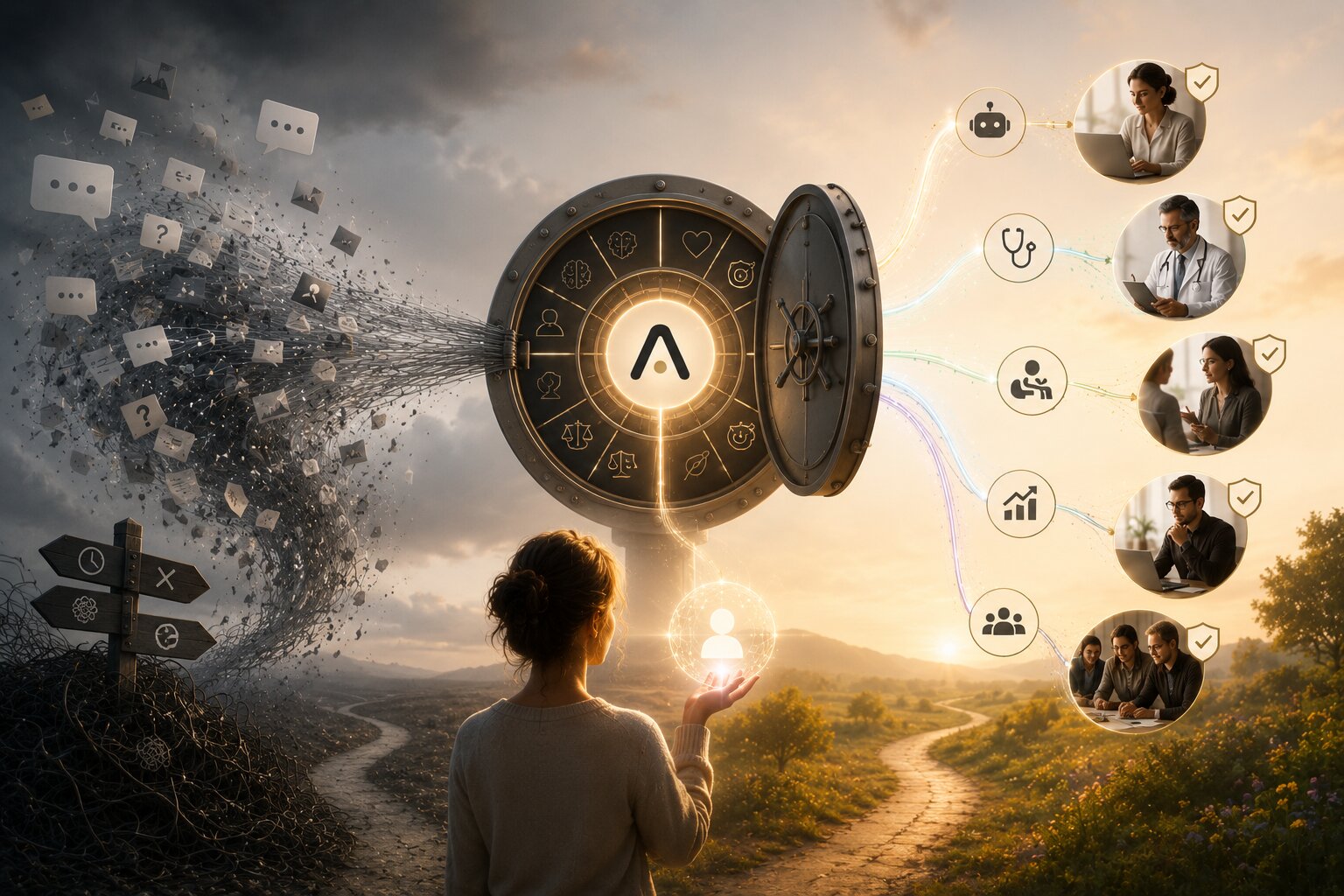
Afini is a strictly personal cognitive profile. It belongs to the subject. The subject controls it. Only the subject decides what to inject into their own tools, and only the subject decides which qualified professional receives it and for what.
This is not a disclaimer at the end of the contract. This is the architecture of the product. And from this flow two practical consequences, one positive and one negative, worth fixing before going further.
The positive: the subject recovers ownership of their cognitive architecture, just as they have the right to own their medical history, and injects it into whoever serves them — their personal AI assistant, their therapist, their coach, their physician — with express, granular, and revocable authorization. It is not a stamp of validation: it is the only way a profile of this kind doesn't become an instrument at the service of anyone with money.
The negative, and here's the important part: Afini is not, must not be, and will not be a tool to profile third parties. We do not sell to recruiters hunting candidates. We do not sell to salespeople trying to decode prospects. We do not sell to companies screening employees without their consent. We do not sell to partners investigating partners. The customer of Afini is always the subject of the profile. Any other use is, simply, misuse, and the product is designed not to facilitate it.
This prohibition is not cosmetic. It is what makes the product defensible — ethically, regulatorily, and reputationally — in an era when the rest will start collapsing. GDPR does not forgive, the European AI Act even less so, and prudent customers have learned the hard way that a product without an ethical perimeter is a bomb on a timer. Afini has a perimeter.
That cleared up, let's continue.
II. The plausible-prior trap
Let's start with the bad news, which is the only honest way to start. A contemporary language model, fed with a decent biographical dossier of the user — professional path, declared affinities, half a dozen habits, a hint of literary references — builds a psychological portrait that an average reader will consider sufficient. Not brilliant: sufficient.
And here's the problem, which is a classic design problem that Donald Norman would have spent years explaining if we'd let him: good enough is the mortal enemy of correct. When something seems coherent, quotable, well-structured, and emotionally plausible, the search stops. The user who receives a plausible portrait of themselves will not commission a better one. They will copy it into a note and use it as a guide for a year, without knowing that at three critical points the portrait points in the opposite direction.
Plausible prior, def.: reasonable hypothesis that, by appearing sufficient, replaces the truth without anyone noticing the change of tenant. Especially dangerous when the tenant pays the rent on time.
What a well-fed LLM produces, in psychometric terms, is a first-order approximation to your Big Five. And the Big Five, worth remembering, is a flashlight. It illuminates the silhouette of the creature. It is enormously useful, has forty years of literature behind it, and is supported by samples of hundreds of thousands of respondents. But the silhouette doesn't tell you whether the creature bites out of fear, calculation, habit, or aesthetic pleasure. For that you need other flashlights, pointing from other angles. The trap is that with just one, it already looks as if you can see the whole animal.
The subject guided by such a portrait makes reasonable decisions about themselves — routines, alliances, projects, therapies — and is systematically wrong one out of four times. Without knowing. Without noticing. With the smile of someone who believes they have read themselves correctly.
III. The three kinds of delta, and only two pay the bills
When you compare a generic-prior portrait with a serious multilayer profile, three classes of difference appear. Worth distinguishing them, because only two generate value, and the third hasn't yet been monetized honestly.
Magnitude delta. Your Openness being 66 instead of 56, or your Extraversion 57 instead of 60, is marketing noise. Any sensible interlocutor rounds you to a point and a half. If a product sold only decimal precision over known figures, it would be an expensive test for people eager to spend money confirming themselves. That market exists. It is not the one we care about.
Practical-sign delta. Here the business begins. It is the difference between believing you have moderate self-efficacy and discovering it is high. Between assuming you are moved by duty and confirming that you despise it. Between thinking you're introverted and discovering you're selective. Same nominal trait, operationally opposite behavior.
A coach designing your intervention with the wrong prior fails not by style: they fail by lever. They pull the opposite lever. And you, who paid for four sessions, leave the process convinced that "coaching isn't for me," when what really happened is that your own cognitive file wasn't in the room. The same happens with a therapist adjusting the frame, with a doctor prescribing antidepressants where what you need is to change bosses, with a personal AI assistant insisting on motivating you with effort-talk when your wiring is allergic to moralized duty.
Anyone selling cognitive profiles who can't explain this delta with a concrete example in under ninety seconds does not know what they're selling.
Non-derivable-layer delta. And here's the structural argument, the one that genuinely shields the product against "ChatGPT already does this." There are dimensions of human behavior that you do not infer from the NEO no matter how many facets you have. Attachment style is not deduced from Agreeableness. Humor style is not deduced from Extraversion. Schwartz value hierarchy is not deduced from Openness. Zimbardo time perspective is not deduced from Conscientiousness.
This is not a methodological detail: it is the clause that distinguishes a product from a trick. If the four additional flashlights were redundant, they'd be unnecessary. They are not. And anyone who has tried to make sensible decisions about their own life knows the silhouette is not enough.
IV. What the Big Five cannot see, however hard it tries
Allow me a brief catalogue, Bierce-style but less cruel, of what a generic prior — however well trained the model, however complete the dossier — cannot infer about you, even when you tell it everything. Four additional flashlights, one for each complementary psychometric test that Afini integrates, worth seeing one by one because the customer is going to ask.
It cannot infer whether your cynicism is defense or luxury. Low Agreeableness with insecure attachment produces a completely different character than low Agreeableness with secure attachment. The first bites because they're afraid; the second, because they can afford to and know the bond won't break. Whoever designs an intervention on the first using the manual for the second — or vice versa — loses months. You, above all, lose months. And that distinction is given by the AAP, not the NEO.
It cannot infer whether your humor binds or dissolves. Some people with high aggressive humor deploy irony as social glue — they laugh at what you laugh at and tattoo you into the group. Others with the same score deploy irony as solvent — they laugh so the other dissolves. Same number, opposite relational code. The clue is in the cross with affiliative and self-enhancing humor. But that cross doesn't appear in the NEO. It appears in the AHP.
It cannot infer whether your engine is to command or to serve. Agreeableness measures how others treat you; Schwartz values measure what you devote your life to when no one is watching. There are altruists who command and dominants who cooperate. Thousands of them. The NEO confuses them elegantly. The AVI-25, which measures Schwartz's circumplex hierarchy, does not.
It cannot infer whether you live in the present by philosophy or by incapacity. The difference between a hedonist by conviction — Epicurus in sandals — and a hedonist by inability to project — the chronic debtor — is almost everything that matters for designing any intervention in one's own life. The NEO throws both into the same "impulsive" drawer. Your therapist and your AI agent, without more data, will treat you as someone you are not. The ATP carefully separates the quantity of present you live from the quality of that present, and that changes the intervention at the root.
Four additional psychometric layers. Four flashlights. Not ornamental: they are what distinguishes "I think I know who I am" from "I know exactly who I am and how not to waste my time."
But — and here comes the twist — even the four together are still not enough. There is a whole other family of data no test in the world will capture, and that family deserves the next section.
V. What no test measures: guided conversations, declarations, and idiographic texture
If the previous section discussed what the Big Five doesn't see but other tests do, this one discusses what no test sees and only the subject can tell. It is the least visible part of the product and, nevertheless, probably the most differentiating. Worth explaining calmly because a serious customer will start salivating, and a careless one will get the chills. Both reactions are reasonable and both must be handled.
Three modes of capture, three epistemologies
The most common error in talking about "cognitive profiles" is throwing into the same sack three different ways of knowing something about someone, as if they were interchangeable. They are not. They are three epistemologies, with three different rigors and three different virtues, and a serious product does not melt them: it mounts them.
The first is the validated psychometric test: IPIP-NEO, AAP, AHP, AVI-25, ATP. What the discipline calls a nomothetic instrument: it measures you by comparing you with a normative sample of hundreds of thousands of respondents. Its virtues are rigor, reproducibility, population norms, convergent validity accumulated over decades of literature. Its limits are that it doesn't capture what wasn't asked, doesn't capture contextual nuance, and produces a portrait in coordinates, not landscape. Useful to place you on a map, not to describe your house.
The second is the AI-guided psychometric conversation. Here Afini does something traditional psychometrics could not do until recently: a language model converses with you following a flexible protocol, extracts dimensions halfway between psychometrics and the clinical interview — cognitive aesthetics, decision style, tolerance for ambiguity, need for cognition, processing modality — and returns scores with declared confidence levels. A hybrid instrument. Its virtue is capturing nuance that the Likert format cannot capture and that a closed test, however good, doesn't dare to ask. Its limit is honest: no population norms, partial dependence on the model and the session, and you should read it with the declared confidence next to it, not as if it were a T-score.
The third is the direct declaration. The subject reports themselves in their own terms. "I wake up at five." "I live in Bilbao, near the office, near the Bilbaína, downtown." "I bill between 620 and 800 euros an hour." "My operational idols are Churchill, Russell, Wagner, Goethe, and Bierce." "I can't stand the time-wasting pest." A purely idiographic instrument: doesn't compare with anyone, doesn't validate against anything, doesn't pretend generality. Its virtue is capturing information no test can ask because the questions don't exist. Its limits are social desirability, occasional lack of self-knowledge, and presentation bias. Important: these three limits also apply to tests, to a lesser degree but they apply, and the adult, well-informed subject manages them.
The three families complement each other, and here is the product's point: the complete profile of an operational human is not sustained by just one of them. The subject with five hours of tests and no conversation is a skeleton without landscape. The subject with five hours of conversation and no test is a texture without coordinates. The subject with declarations but neither of the other two is a résumé with a varnish of introspection. The three together, each serving what it serves and acknowledging what it doesn't, give something none of the three gives by itself.
The antimodel: the most underrated tool
There is a category within declarations that deserves its own paragraph because almost nobody pays attention to it and it is probably the most revealing. It is what Afini calls the negative space: the catalogue of what the subject rejects, avoids, finds boring, or finds disgusting.
In literature it was intuited by Richard Brautigan, whose characters are always defined more precisely by what they do not want — by what they refuse to be — than by what they say they want. In clinical work, Adam Phillips formulates it with his usual elegance: tell me what you flee from and I'll tell you what you're defending. In organizational consulting, Gerald Weinberg said the same thing all his life in another idiom: what a system rejects says more about its architecture than what it accepts. Three different crafts — literature, psychoanalysis, systems engineering — saying the same thing from three directions. When that happens, listen.
Negative space, def.: catalogue of the subject's operational aversions, far more resistant to social lying than the catalogue of declared affections. He who claims to love honesty may be faking; he who says he cannot stand the time-wasting pest rarely fakes.
A subject who declares as a high-severity pet peeve "conversations that repeat what's already been heard," and doubles that with "if it bores me or not, if it surprises me or not," is saying something no test on the market will extract. He is saying his cognitive filter prioritizes freshness over depth, his tolerance for triviality is practically zero, his attentional economy is strict, and that filter operates without background anxiety: he doesn't stay trying to be polite, he leaves. That, crossed with high Openness and low Agreeableness, predicts very concrete behavior in meetings, training sessions, after-dinner gatherings, classrooms. And it also predicts the type of professional relationship he will sustain and the type he will not. It is highly operational data. And it was in none of his six tests. He declared it, in his own words, without preset items, and he declared it well.
The negative space is also psychometrically cleaner than it seems. People lie less about what they detest than about what they admire, for the simple reason that pure hatred has less social reward than declared virtue. A subject saying "I love honesty" may be faking; a subject saying "I can't stand the pests who waste my time" is rarely faking. He is speaking.
Methodological honesty about the rigor of soft tools
Time to say something that some defenders of the product prefer not to say, and that is nevertheless the only way to defend it with a straight face in front of a discerning customer: conversational and declarative tools do not have the psychometric rigor of validated tests. They are not normed to populations, they have no manual-reportable Cronbach alpha, they are not reproducible in the strict sense. If a regulatory customer demands classical psychometric rigor for that part of the profile, the soft tools won't give it. And lying to the customer by saying they do is the short road to disaster.
What is asked of the soft tools is something else: capturing what nomothetic rigor cannot capture. It's the classic trade-off between nomothetic and idiographic validity that clinical psychology has known since Gordon Allport and still hasn't quite resolved, because it has no single solution: it depends on what you want the data for.
Afini does not resolve the tension; it mounts it as product. The tests give the normed skeleton. The conversations give the contextual landscape. The declarations give the idiographic texture. Each thing where it shines, each with its limits declared, none pretending to be what it is not. The customer receives the three kinds of data labelled as such — in some cases with an explicit confidence field beside them — and decides what weight to give each according to use.
Selling this without that methodological honesty is selling smoke. Selling it with that honesty is selling exactly what the serious operational customer needs and can't find: a system that recognizes where it is soft and where it is hard, instead of painting it all the same color with a carnival Photoshop.
Why this matters for the profile's owner
Worth closing this section with the practical consequence for the subject, which is whom we have been talking about all along and sometimes forget. A profile combining tests, conversations, and declarations allows the subject, their authorized digital tools, and their authorized professionals to do something concrete: not ask the same thing twice, not propose what was already ruled out, not schedule meetings at hours when the subject doesn't perform, not recommend therapies the cognitive architecture already predicted would fail, not waste time on the "let me tell you about me" phase. Not magic: just having done the homework before starting.
That, translated into a life with many points of digital friction and many professionals passing through, is hundreds of hours per year the subject recovers. The estimate is conservative.
VI. The sales argument, without diplomacy
Whoever sells this as "a more complete portrait of you" loses. The word complete is fairground. The complete doesn't exist and the customer knows it.
What is sold is something else, much less romantic and much more billable:
Afini, operational def.: your cognitive architecture in portable format, exclusively your property, which only you decide to share and only with whom you choose, so that the decisions made about you — including those you make yourself, those your digital tools make on your behalf, and those made by the professional you authorize — are made with the correct information and not with what was inferred by groping.
That sentence pays salaries. Let's unpack it, because every word counts.
Your cognitive architecture: not a "report," not a "result," not a "test." An object describing how you process, how you decide, how you bond, how you laugh, what you value, when you perform, what you reject. There is a difference between the verb describe and the verb evaluate. Afini describes. Whoever wants to evaluate must look elsewhere.
In portable format: not a session that evaporates, not a PDF that gets lost, not a conversation that is forgotten. A digital object that travels with you and plugs into the places where you need it. Portability is half the product.
Exclusively your property: here goes the ethical and commercial line at the same time. The profile belongs to the subject. The subject keeps it. The subject deletes it whenever they please. There is no copy in the hands of a third party who can use it without your current authorization.
Which only you decide to share and only with whom you choose: consent is the only entrance to the product. Granular, revocable, per use. Not a single tick at signup: a series of specific decisions you make each time an agent, an assistant, or a professional wants to access your layers.
The decisions made about you: and here are the three types of legitimate decider. First, you, about your life. Second, your digital tools acting on your behalf and under your mandate. Third, the qualified professional to whom you explicitly grant access in order to help you. No one else. Never.
With the correct information and not what was inferred by groping: the anchor. Not "to know yourself better." Not "for your personal development." So that inferences made about you, by you, or by your delegates, are made on data — tests, conversations, and declarations — and not on guesses. Whoever does not understand this is not your customer and is not worth convincing.
VII. Who buys this, and who doesn't
Sacha Guitry used to say that in any important matter you should start by ruling out the people who will not take part in it. Worth applying here.
Buys this:
- The subject who wants to install serious tools upon themselves — routines, life decisions, evaluation of their own alliances — without the adolescent temptation to simply believe what a test says nor the other, equally adolescent, temptation to believe nothing. This is Afini's principal customer, and worth putting first because we sometimes forget.
- The subject who uses AI agents in everyday life and is tired of having to re-explain to each one how to speak to them, when they perform, what feedback works and what insults them. They inject their Afini into their own personal assistant, their own copilot, their own management system, and stop losing the first fifteen minutes of every conversation to the "let me tell you about me" phase. Here Afini is not a luxury: it is personalization infrastructure, in a historical moment when personalization is the only serious front left for LLM-based products.
- The subject who decides to share their Afini with a qualified professional they have authorized to accompany them through some stretch of life. This includes psychiatrists, clinical psychologists, therapists with verifiable credentials, family doctors, serious coaches with traceable training, professional mentors in explicit contractual relationship. Authorization is specific to that relationship, lasts as long as the relationship lasts, and is revoked the day the subject decides. The professional receives the file and saves the three or four sessions they would have spent triangulating the patient's attachment style. The subject saves those three or four sessions and the corresponding money. And, above all, the intervention starts on day one with the correct lever.
- The subject who decides to share it voluntarily with concrete people in their intimate sphere — a partner, a co-founder, a long-standing mentor — because they understand that those people will make better joint decisions if they know whom they are deciding with. This is not profiling: it is voluntary transparency, and it is exactly the same logic by which one shares a medical diagnosis with the partner one lives with.
Does not buy this, and worth saying it aloud because the misunderstanding is expensive:
- Recruiters trying to screen candidates. Even if a candidate could, in theory, decide to share their Afini to speed up a process, the product is not designed or sold for that, and the power asymmetry in a job interview invalidates any apparent consent. Not our market.
- HR departments trying to profile employees. For the same reason, multiplied.
- Sales teams trying to decode prospects. The subject of an Afini is always the one carrying the Afini, never the one across the table. Selling the opposite is selling something else — something worse.
- Private investigators, suspicious partners, curious in-laws, anxious parents. The consent of the autonomous adult subject is the only door, and a third party's curiosity — however legitimate it feels — does not open it.
- The curious type who wants to know which Hogwarts house is theirs. They have free tests on the Internet.
- The one who thinks they already know themselves. By definition, that customer doesn't buy. And, by definition, that customer is wrong twice as often as average.
Not your market. Don't want them to be. The money of the first weighs the same in the bank, but the reputational and regulatory cost of accepting it is ruinous on a three-year horizon.
VIII. The clinical argument: why an imprecise prior is dangerous for the subject
Adam Phillips — who knows more about this than anyone, and with more elegant prose — has written extensively about the problem of apparent fit. An interpretation that almost hits is worse than one that openly misses, because the one that misses gets discarded and the one that almost hits gets incorporated.
Applied to cognitive territory, and applied to the subject working on themselves: a reasonable portrait placing someone at the wrong coordinate of a single critical axis — attachment, values, humor, time perspective, chronotype, antimodel — is not experienced as error but as description. The subject sees themselves reflected in eighty percent of the portrait and assumes the remaining twenty is also correct, even if it doesn't quite fit. And in that twenty was precisely the clue that decided what to do with their next decade.
Applied to the subject working alone on their own life, this is exactly the mechanism by which one makes bad decisions with high confidence about oneself. Applied to the subject working with their authorized therapist, this is exactly the mechanism by which a good therapy takes three months longer than it should. Applied to the subject injecting partial data into their AI assistant, this is exactly the mechanism by which that assistant, with the best will in the world, insists on a routine the cognitive architecture has rejected since day one.
Serious psychometrics — and honest guided conversation, and well-collected direct declaration — exist, in part, to prevent that blind confidence. Not to replace the subject's judgment about themselves: to prevent that judgment from resting on evidence that looks more solid than it is.
And this, worth underlining, is not an argument against LLMs. It is an argument in favor of giving the LLM you are using the data it needs not to infer badly about you. Afini does not compete with the language model: it equips it with the information you decide it should use.
IX. The hard objection, and the answer without rhetoric
There are two serious objections that deserve serious treatment, not smoke. The first is methodological; the second, commercial.
The methodological objection. "AI-guided conversations are not validated tests. How do you defend their rigor in a product that also sells five serious psychometric instruments? Aren't you mixing pears with dynamite?"
The answer is: we don't defend them with the same rigor as the IPIP-NEO, and we don't pretend to. We defend them as complementary phenomenology with declared confidence next to every score. Classical psychometrics seeks population-normed measures; the guided conversation seeks idiographic captures a closed test cannot ask for. Two different epistemologies, both with a place in an operational profile, provided each is labelled as what it is. The error would be using the conversation as if it were a test, or the test as if it were an interview. Afini does not make that error: each tool used for what it serves, each one declaring its limits. Whoever wants a product using only the nomothetic has loose tests on the Internet, cheap and honest. Whoever wants a product using only the idiographic has a coach. What we offer is the honest integration of the three modes, not the cheating fusion that equates them.
The commercial objection. "Let's accept that the additional layers add information the NEO doesn't capture. Why do I need a product that integrates them? Couldn't I take each test separately, pay thirty euros for each, and join them myself in a spreadsheet?"
The answer has three parts, all true.
First: you could. But you won't. The friction of taking six separate tests, in different interfaces, with different normings, without temporal synchronization, without cross-reading, plus the guided conversation separately, plus collecting your own declarations systematically, is enough to make ninety percent of those who try stop at two. Donald Norman has been explaining it for forty years: friction is not an implementation detail, friction is the implementation.
Second: even if you did them all, you would lack what truly matters, which is not the sum but the cross. Knowing you have secure attachment and high aggressive humor and low Agreeableness and a declared antimodel against triviality is not knowing four things: it is knowing a fifth, different one, that only emerges when read together. The cross-layer protocols are not ornamental; they are the only serious reason a product like this exists rather than a kit of loose tests sold by the unit.
Third, and this is the important one: what you pay is not the sum of the tests plus the sum of the conversations. It is the structured portability of the result under your exclusive control. A profile you can inject into the AI agent you use, into the personal management system you keep, into the conversation with the therapist you chose, without having to re-explain yourself each time, and with the guarantee that file does not circulate elsewhere. The sum of six loose PDFs does not have that. Only a file designed, stored, and authorized for that has it.
The product, in the end, is not the content. It is the format and the ownership in which the content travels.
X. The conclusion, no flourish
If I had to summarize all this in one sentence for an investor in a hurry, it would go roughly like this: the cost of being wrong about oneself is rising, the generic priors of LLMs about users are reducing their error rate at a slower velocity than the velocity at which that cost rises, and meanwhile the social and regulatory demand for the subject to be absolute owner of any profile inferred about them is growing.
At the intersection of those three curves lives Afini. If the first keeps rising — and everything points to yes, as automated decisions become more consequential in daily life — the product's space widens. If the second drops very fast — which can also happen — part of the value erodes from the "magnitude delta" flank, but the "practical-sign delta" and the "non-derivable-layer delta" hold, because they are architectural, not statistical. And if the third curve — personal cognitive sovereignty — keeps being what it appears it will be in Europe over the next decade, then the product's strict perimeter shifts from being a limitation to being its greatest asset.
To this is added a fourth vector, pointing directly at what was discussed in section five: as AI-guided conversation matures as an instrument, what is today the softest part of the product can become one of its strongest, simply because no competitor selling only tests will be able to capture what Afini captures by conversation, and no competitor selling only conversation will be able to back it with the psychometric skeleton Afini does have. The combination is defensible. The isolated part, much less.
That, translated into business language, means the product has long-term defense as long as it remains faithful to its thesis. We don't sell a prettier portrait of the subject. We don't sell a tool to evaluate others. We don't sell yet another psychometric test. We sell the difference between the subject making reasonable decisions about themselves and making correct decisions about themselves, captured with three types of instrument, mounted with methodological honesty, and delivered in a format of which they are the exclusive owner.
Reasonable is what any contemporary language model offers you for free about yourself, in exchange for your chats.
Correct is what you — and only you, and whomever you decide to authorize to walk a stretch with you — need so as not to waste your life.
And for correct, worth remembering, there has always been someone willing to pay. Those people are still there. Those people, in Saki's terms, tend to have a better sense of humor than average and considerably less patience for chatter.
That is: our people.
— Ricardo Devis Botella · Bilbao